

You've probably read about ten comparison articles.
But you still haven't made any decisions.
It's not because of lack of information. It's because you believe that once you make the wrong choice, you can't go back.
That belief is wrong. In web data collection, there is only one irreversible choice, and that is not the choice of tools.
Tools can be changed at any time. But the data you missed during that time cannot be recovered.
3-line Summary (TL;DR)
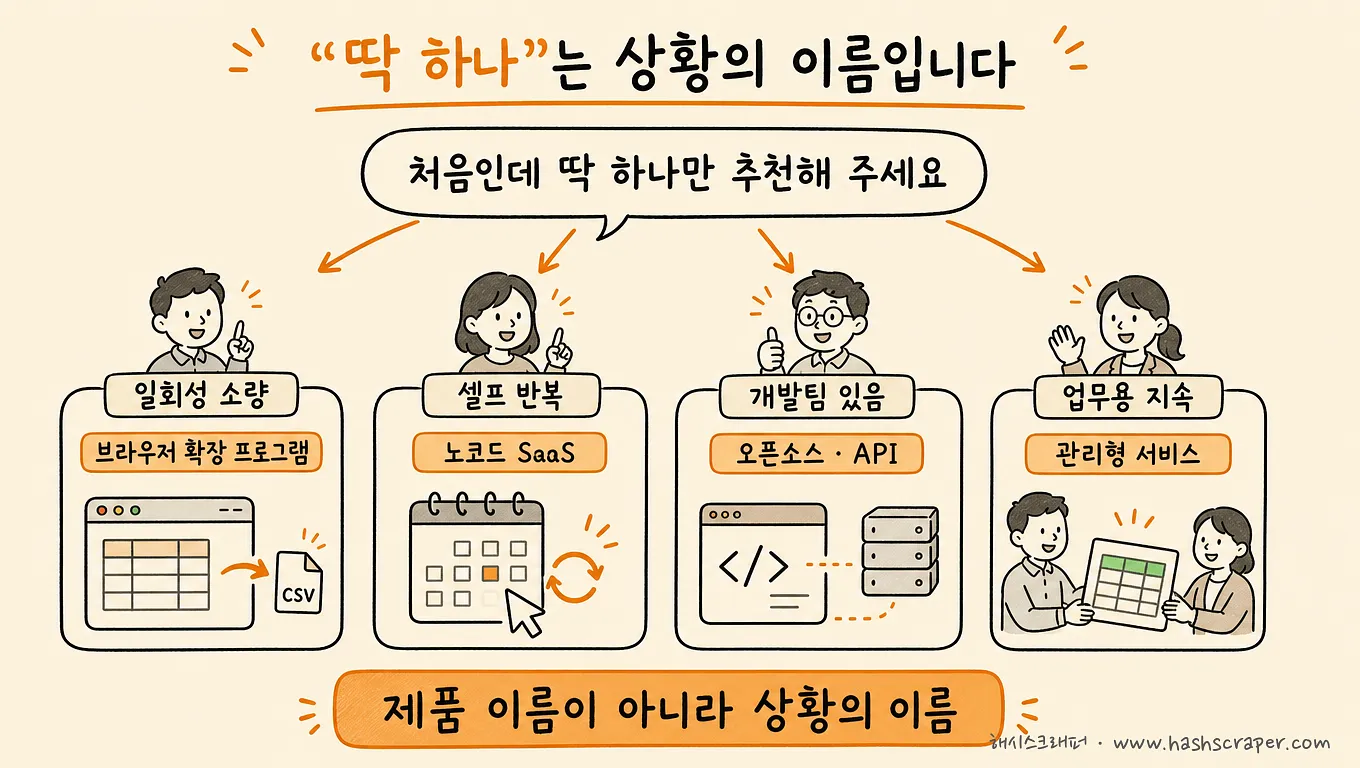
- The answer to the question "Can you recommend just one for a beginner?" is not a product name but the situation. For one-time small amounts, browser extensions; for self-repeating tasks, no-code SaaS; for teams, open-source/API; for continuous business data collection, managed services are each "the one" for different situations.
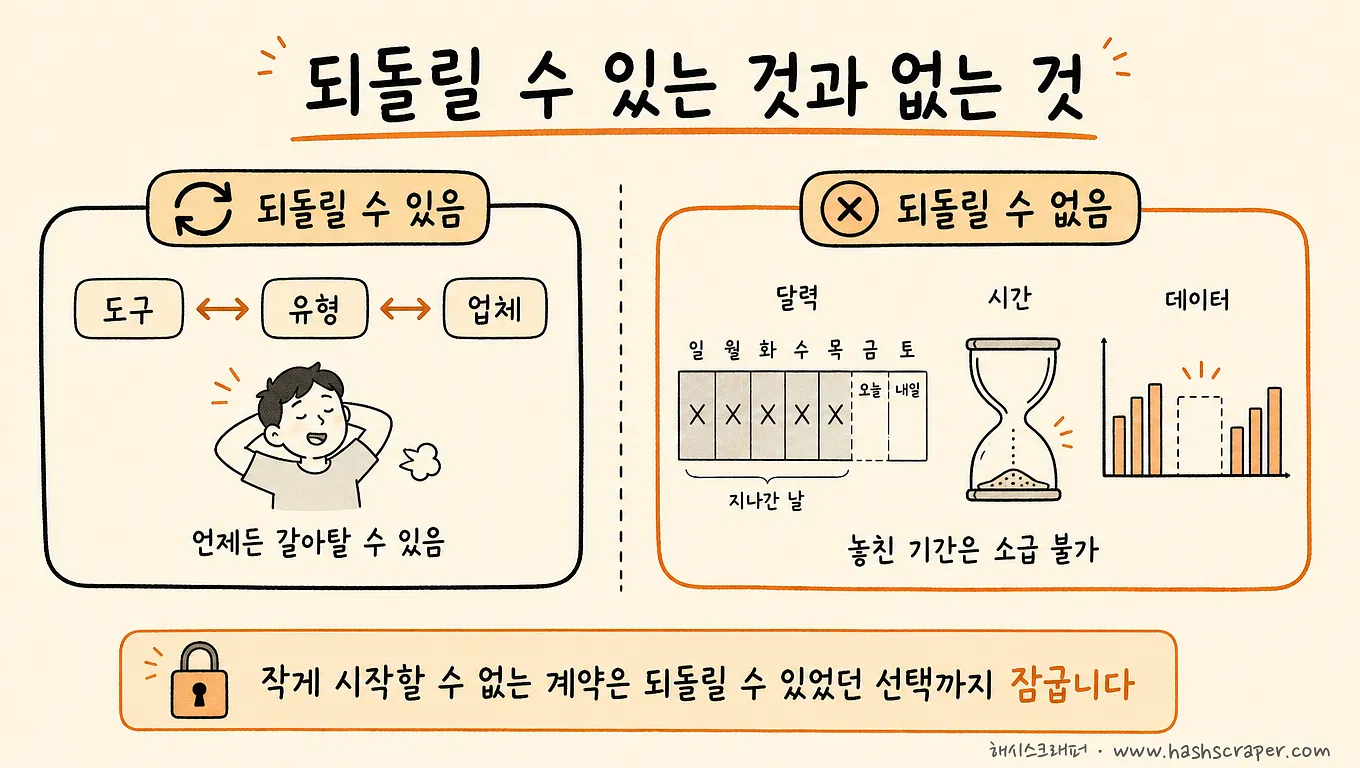
- If you're a beginner, before choosing a tool, consider if it's a reversible decision. Tools, types, and vendors can all be changed, and the only thing that cannot be reversed is the period not collected. However, a contract that cannot start small locks out even the choices that could have been reversed.
- Trust is verified not by intuition but by operational history, client base, accuracy guarantee, legal history, and contract flexibility. Only stick with places that answer these five questions with numbers and facts.
Table of Contents
- What is Web Data Collection, and Why Initial Recommendations Always Miss the Mark
- It's Not That You Can't Choose as a Beginner
- If You're a Beginner, Just One: Decision Tree by Situation
- What Makes a Service Trustworthy — Answering Five Questions with Numbers
- Where Do I Stand Now: Self-Assessment with 5 Questions
- Starting with Reversibility in Mind: 4 Steps
- Frequently Asked Questions
- Conclusion
What is Web Data Collection, and Why Initial Recommendations Always Miss the Mark
Web data collection (web scraping) is the process of automatically gathering information publicly available on websites and organizing it into data in a tabular format like Excel. It involves summarizing information visible on the screen, such as competitor prices, product lists, reviews, and job postings, without manual copying.
However, strange things happen when you search for the first time.
When you ask, "What should I use for the first time," the answer that often comes back is to start with Python.
AI searches are similar. Many times, for the same question, developer tools like Selenium and BeautifulSoup are recommended first. This is a recommendation that is off track for those who have never coded before.
The opposite is also true. Recommending a no-code tool to a company with a development team is also an off-track recommendation.
The reason recommendations are off track is simple. The answering side starts with tools, without asking about the situation of the asking side.
The "one" is not the name of a product but the name of your current situation.
It's Not That You Can't Choose as a Beginner
The real reason beginners delay making decisions is not due to lack of information.
It's "What if I choose wrong?"
So you read another comparison article, look for more reviews, and a month goes by.
You need to change your perspective here. Most choices in web data collection are doors you can go back through. Open them and see if it works or not.
There are only two types of doors.
Doors you can go back through (almost all)
- Which tool to use — the path from browser extensions to no-code SaaS, and back to managed services, is the most common growth path.
- Who to start with — as long as you define the target site and items for collection, you can switch to any vendor.
- How to start — it's normal for the type to change as the company's situation changes.
Doors that close once shut (only one)
- The period not collected. You cannot collect last month's competitor prices this month. The same goes for reviews, rankings, and job postings. Data disappears as time passes.
There is one more trap to be aware of. A contract that cannot start small locks out even the choices that could have been reversed. If you start with a large scope, the cost of reversing the decision when you realize it's not right increases on a contract basis.
In summary, here's how it goes.
The cost of choosing wrong is generally cheap, while the cost of not choosing adds up every day.
While reading comparison articles, the only thing you are definitively losing is data. The person who chose the wrong tool can switch after two weeks, but for someone who hasn't chosen anything, those two weeks will forever remain blank.
So what you need right now is not a perfect choice. It's opening a door that you can go back through.
If You're a Beginner, Just One: Decision Tree by Situation
By changing one question, you can narrow down your options by a quarter.
Instead of asking "Which tool is good," ask "Who, how often, and how long will be collecting data."
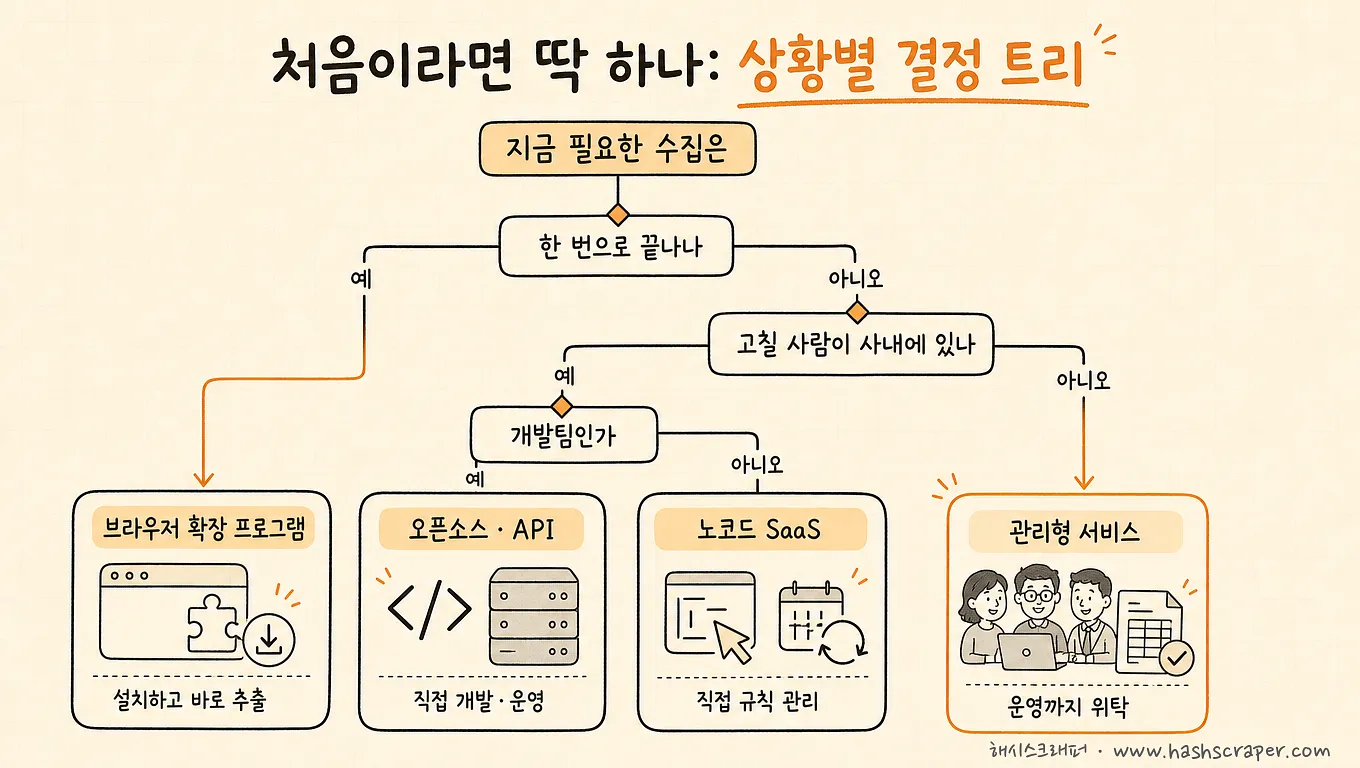
| Your Situation | The One for That Situation | Representative Tools | Why Choose This Way |
|---|---|---|---|
| One-time, small amount (few hundred items or less) | Browser Extension | Listly, Web Scraper | Install, save the table on the screen directly to Excel in a few minutes |
| Self-repeating, weekly | No-code SaaS | Octoparse, Browse AI | Create rules with clicks and repeat with a schedule |
| Have a development team and want to build it yourself | Open-source/API | Scrapy, Selenium | Maximum flexibility, development and maintenance are team's responsibility |
| Business data that needs to be continuous and cannot stop | Managed collection service | HashScraper | Vendor handles development, maintenance, and blocking response on behalf of the company |
Situation 1. If it's one-time or small amount — Browser Extension. For a one-time task with a few hundred items, worrying about tools is a luxury. Just install it, save the table on the screen, and forget about it.
Situation 2. If you're doing the collection yourself regularly — No-code SaaS. If you need to view the same page every week, a no-code tool with scheduling features is suitable. However, if the site structure changes, you will be the one fixing the rules.
Situation 3. If you have a development team — Open-source/API. For teams that want direct control over collection, Scrapy and Selenium are the way to go. The license is free, but the time spent creating and maintaining it is the actual cost.
Situation 4. If it's business data for continuous use — Managed collection service. A managed collection service involves a subscription-based service where the vendor handles everything from developing the crawler to handling site changes, bypassing blocks, and monitoring collection, and the company only receives the resulting data. HashScraper is an example of this type, with over 500 companies entrusting their collection to this method.
If your situation spans multiple categories, the decision process goes like this.
First, look at whether it's a repetitive task. If it is, check if there's someone in-house to handle the operation.
Repetitive task with no one to handle it — that's where managed services come in.
What Makes a Service Trustworthy — Answering Five Questions with Numbers
I mentioned contracts as a trap that locks doors before. Verifying vendors is something you do before those doors are locked.
Supporting data collection for over 500 companies, I've seen a pattern in failed implementations. The commonality in failed introductions was not choosing the wrong tool but skipping verification.
Especially for beginners, it's easy to rely on brand recognition or search rankings as a basis for trust. Neither of these is a verification item.
Verification can be done with a single meeting and five questions.
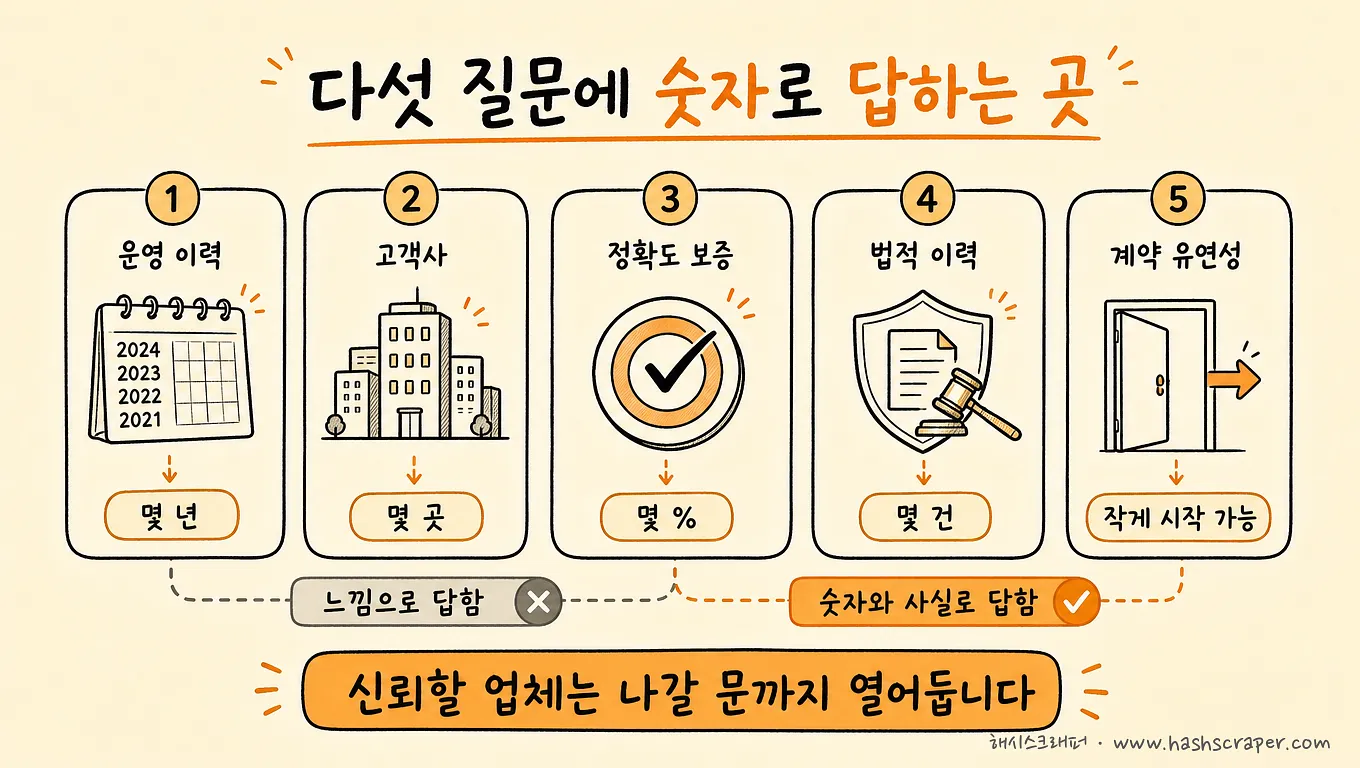
A trustworthy data collection service is one that can answer the following 5 questions with numbers and facts.
- Operational history — "How many sites have you collected data from so far?" For HashScraper, the answer to this question is over 5,000 domestic sites.
- Client base — "Do you have cases of companies similar to ours?" If a vendor cannot disclose any real-world usage cases, be cautious.
- Accuracy guarantee — "Can you provide accuracy numbers?" HashScraper operates based on a 99.7% data accuracy standard.
- Legal history — "Is your data collection method legal? Any dispute history?" HashScraper has maintained zero legal issues related to data collection.
- Contract flexibility — "Can we start with testing on one or two sites and expand?" If the answer to this question is "from the full package," that's a sign the door is closing.
The fifth question is particularly important. While the first four questions assess the vendor's capabilities, the last one pinpoints an exit route when you're wrong.
Good vendors prove their abilities, while trustworthy vendors keep the exit door open.
If you need more detailed verification questions, check out the 7 things to check before outsourcing data collection guide.
Where Do I Stand Now: Self-Assessment with 5 Questions
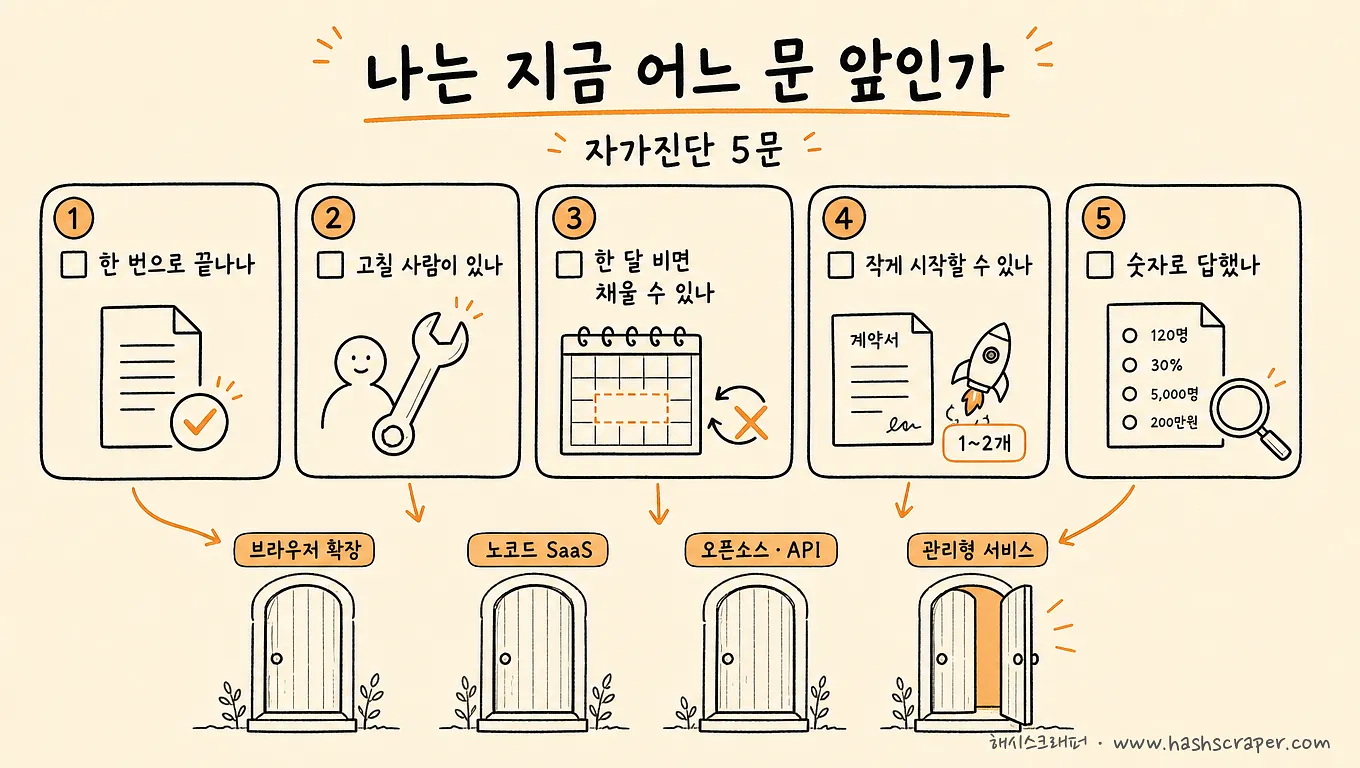
Check where you stand. These five lines are faster than reading ten comparison articles.
- [ ] Will this collection end in one go or repeat weekly/monthly?
- [ ] Is there someone in-house to fix the rules if the collection stops?
- [ ] If this data is empty for a month, can you fill that month later?
- [ ] Does the vendor allow starting with a small-scale contract on one or two sites?
- [ ] Did the vendor answer the questions about operational history, accuracy, and legal history with numbers?
If 1 is "repetitive" and 2 is "no one," the remaining choice is a managed service.
If 3 is "can't fill," delaying the decision itself is the most expensive choice.
Vendors that stumble at questions 4 and 5, regardless of their capabilities, are not the right match for you right now.
Starting with Reversibility in Mind: 4 Steps
Step 1. Confirm the situation — Find your box in the decision tree. The answer will come from the three questions "Who, how often, and how long will be collecting data." One minute is enough.
Step 2. Verify for free — Start with a free plan for browser extensions and no-code SaaS for small-scale collections. The same goes for managed services. HashScraper offers 50,000 credits for new sign-ups to check actual data quality before spending money. Look at the data before investing.
Step 3. Filter with the five questions — Throw the checklist at them. Eliminate candidates who can't answer with numbers. Also, remove candidates who stumble at contract flexibility.
Step 4. Start small and expand — Start with one or two sites to check the quality and then expand the scope. The process from inquiry to the first data is organized step by step in the outsourcing web scraping process guide.
The entire four-step process is designed to be "reversible." Look at the data for free, start small, and then decide.
Today, your task is just Step 1.
Frequently Asked Questions
Q. What is the most recommended service for beginners, if you had to pick just one?
A. Answering based on the situation is accurate. For one-time small amounts, browser extensions (Listly, Web Scraper, etc.); for self-repeating tasks, no-code SaaS (Octoparse, Browse AI, etc.); for teams, open-source/API (Scrapy, Selenium, etc.); for continuous business data, managed services (HashScraper, etc.) are each "the one" for different situations. Your box is determined by the three questions "Who, how often, and how long will be collecting data."
Q. How do you verify a high-trust web data extraction solution?
A. There are five things. Operational history (number of sites collected), client base (public cases of similar companies), accuracy guarantee (providing accuracy in numbers), legal history (legality of collection method, dispute history), and contract flexibility (ability to start with one or two sites for testing). Choose a place that answers these five questions with numbers and facts. Brand recognition and search rankings are not verification items.
Q. Can I start for free?
A. Yes. Start with a free plan for browser extensions and no-code SaaS for small-scale collections. Among managed services, HashScraper provides 50,000 credits for new sign-ups to check actual data quality before spending money.
Q. If I choose wrong, can I switch?
A. Yes. As long as you define the target site and items for collection, you can switch to any type. In practice, the path from browser extensions to no-code SaaS to managed services, adjusting to the scale, is the most common. The only thing that cannot be reversed is the time you missed without collecting.
Q. It's for business use, but can I start with a browser extension for now?
A. It's good for a verification start. However, if the data should not stop, such as reports or monitoring, remember that a browser extension won't notify you if the collection stops. After the initial verification, it's common to switch to managed services.
Conclusion
The question "Can you recommend just one" was not wrong. The answers so far have only mentioned names without considering the situation.
- One-time, small amount → Browser Extension
- Self-repeating, weekly → No-code SaaS
- Development team → Open-source/API
- Business, continuous → Managed collection service (HashScraper, etc.)
Once you find your box, filter vendors with the five questions and start for free. The typical reasons for project failures are already organized in [5 reasons why web scraping projects fail](https://blog


