

"We collected 30,000 reviews."
The moment this sentence appears in a report, no one asks the next question.
30,000 out of how many?
If the total is 40,000, that is excellent data. If the total is 400,000 and only the 30,000 most recent ones were scraped, that is not VOC but a collection of people who were recently angry.
The same 30,000 reviews. Completely opposite conclusions.
Where review analysis goes wrong is usually not the analysis. It is the sample.
3-Line Summary (TL;DR)
- The key criterion for choosing a review/VOC collection service is not "how much can it scrape," but "which part of the population did it capture, and how?" Incorrect prices eventually become noticeable, but missing reviews are not on the screen, so they remain unnoticed forever.
- Reviews differ fundamentally from prices and inventory. Their creation dates are spread across the entire past, pagination and sorting move even during collection, and duplicates and omissions occur at the same time. This is not about getting one current value right; it is about securing the entire historical record without gaps.
- There are three approaches. For small-scale, one-time checks, use no-code tools (Thunderbit, Octoparse, etc.); if you have a development team, choose in-house development (Scrapy, Zyte, Firecrawl, etc.); if you need daily VOC from entire channels without development staff, use a managed collection service (Hashscraper offers this approach with experience collecting from over 5,000 domestic sites, proxies in 195 countries, and 99.7% data accuracy).
Table of Contents
- What Are Review Collection and VOC Data?
- Reviews Are Different from Prices: Missing Data Is Not on the Screen
- Five Ways Samples Become Biased
- Decide What to Include First: Designing Review Collection Fields
- Why E-commerce Reviews Are Especially Difficult: Blocking, Login, and Personal Data
- Comparison by Approach: No-Code Tools vs. In-House Development vs. Managed Services
- Five Self-Diagnosis Questions Before Signing a Contract
- Five Implementation Steps
- Collection Is Followed by Analysis
- Frequently Asked Questions
- Conclusion
What Are Review Collection and VOC Data?
Customer VOC data refers to the complete record of customer reactions to products and services that remain in text form, such as reviews, ratings, inquiries, and social media mentions.
There is one difference from surveys. Customers leave it first without us asking. That is why the volume is large, formats vary widely, and the data is scattered across multiple channels.
Review collection is the task of automatically retrieving this text, scattered across shopping malls, app stores, maps, and communities, at defined intervals and consolidating it into a single table.
This already requires two decisions: how far to collect, and what to include in each row. The practical difference between services is who takes responsibility for these two decisions.
Reviews Are Different from Prices: Missing Data Is Not on the Screen
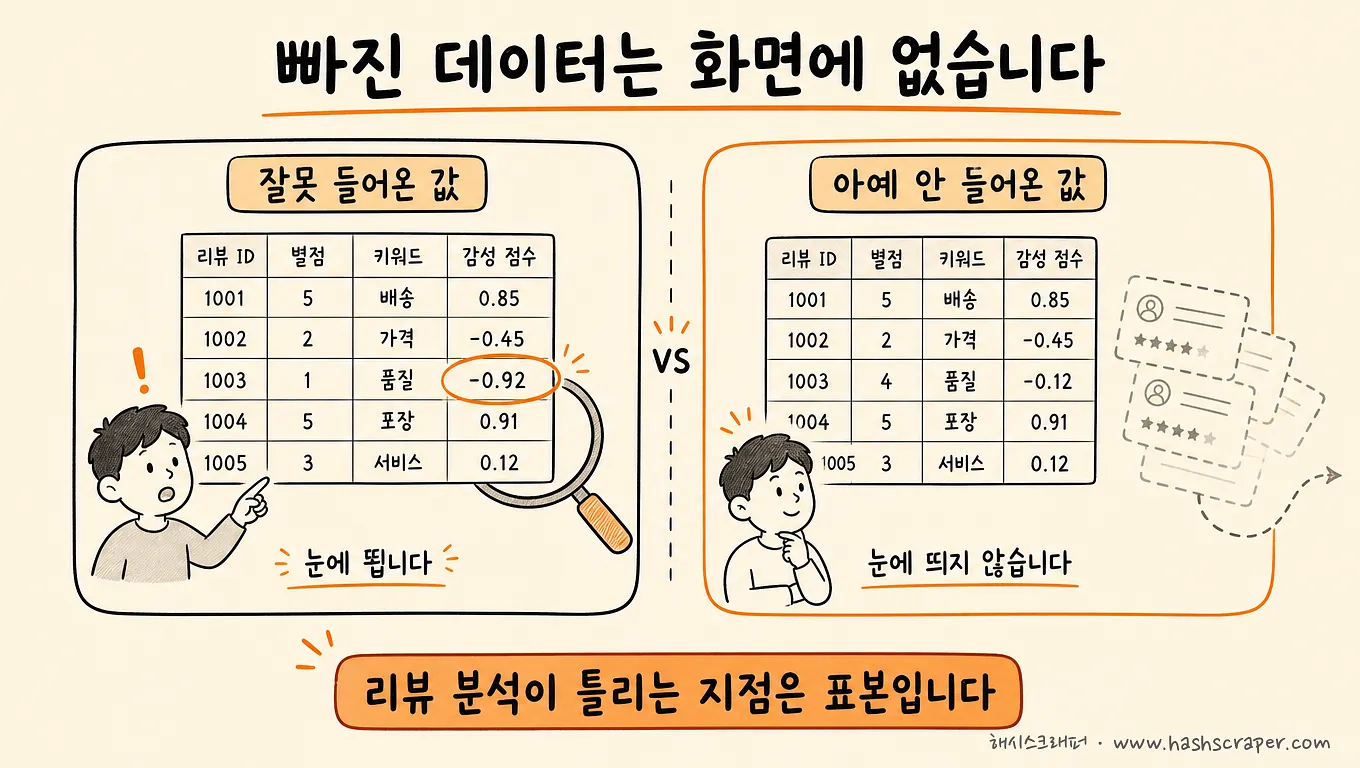
A price is one value at this very moment. Even if it is captured incorrectly today, it can be measured again tomorrow.
Reviews are a collection of the entire past. Three years of reviews may be accumulated, and both yesterday's review and one from three years ago are equally valid.
This difference creates five practical challenges.
- Creation dates are distributed — they are not all on one screen. You must paginate to the end to complete the sample.
- Pagination runs deep — a single product can have dozens or hundreds of review pages.
- Sorting moves during collection — if new reviews arrive while you are reading page three, all subsequent pages shift.
- Duplicates and omissions occur simultaneously — you collect the same reviews again due to shifting, while missing others by the same amount.
- The answers are beyond star ratings — an average rating of 4.3 explains nothing. The reasons are in the text, options, and images.
Then comes the decisive difference. If a price is wrong, someone eventually says, "This number looks strange." You can compare it to what is on the screen.
No one mentions missing reviews. What does not exist does not appear in the table.
Incorrectly collected data stands out. Data that was never collected does not.
Five Ways Samples Become Biased
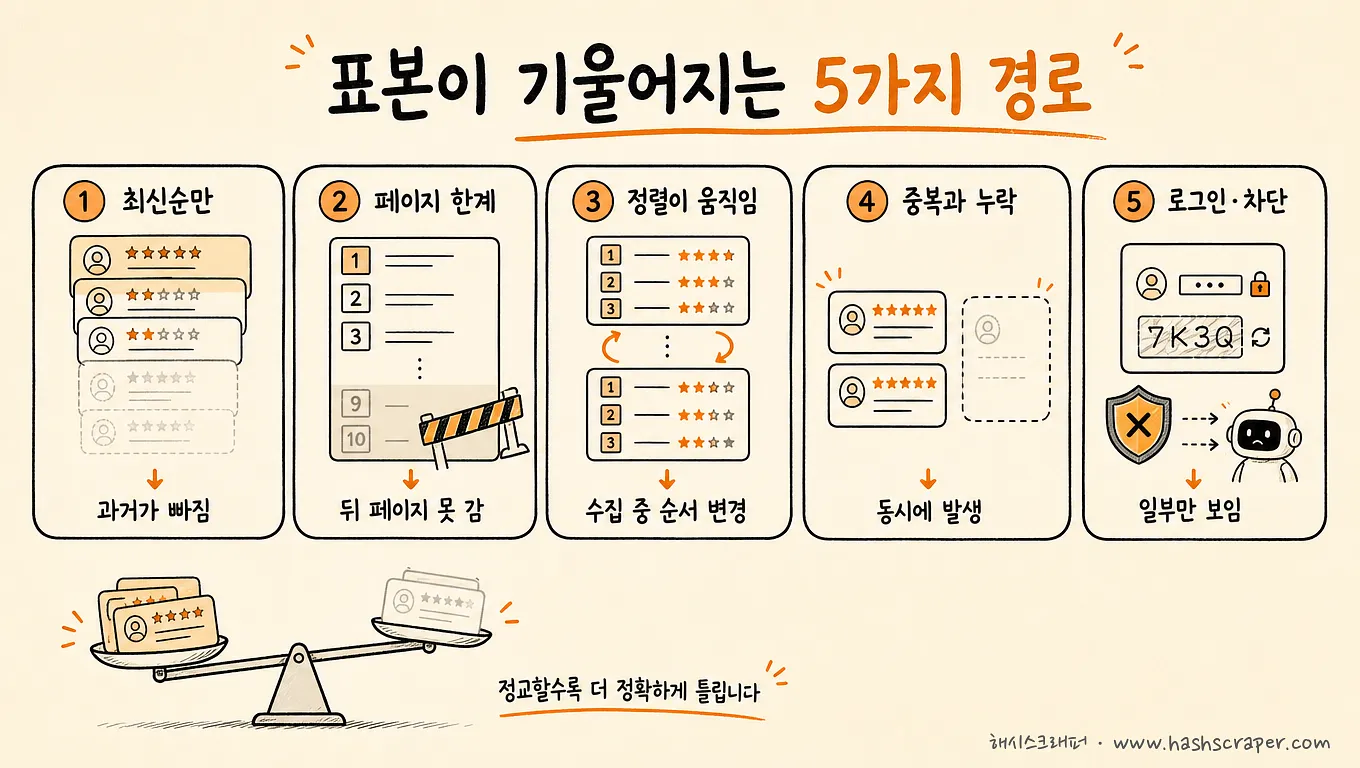
Across review data observed while supporting collection for over 500 companies, nearly every failure fell into one of these five categories.
1. Most-recent bias. If the default sort order is most recent and you scrape only the first few pages, the sample becomes concentrated on the "recent" period. Reviews vary completely by period depending on seasons, promotions, and quality issues.
2. Page-depth cutoff. If collection is fixed at "up to 20 pages," everything beyond that becomes nonexistent data. The problem is that popular products are cut off more severely. The most important products suffer the greatest damage.
3. Duplicates and omissions caused by sort changes. If new reviews arrive while collection is running, the order shifts. Without using unique review IDs as the basis, the same review enters twice while other reviews never enter at all.
4. The best/helpful-sort trap. If you collect only the "Best Reviews" tab, the sample becomes biased toward positive reviews. These are reviews selected by the platform to be shown.
5. Channel omissions. If a channel is excluded due to blocking or login requirements, the entire customer segment that uses that channel disappears. VOC without app reviews is VOC without the voices of app users.
All five paths share one thing: the report still looks perfectly fine. Charts are drawn, negative ratios are calculated, and word clouds look attractive.
When the sample is biased, the more sophisticated the analysis, the more precisely wrong it becomes.
Decide What to Include First: Designing Review Collection Fields
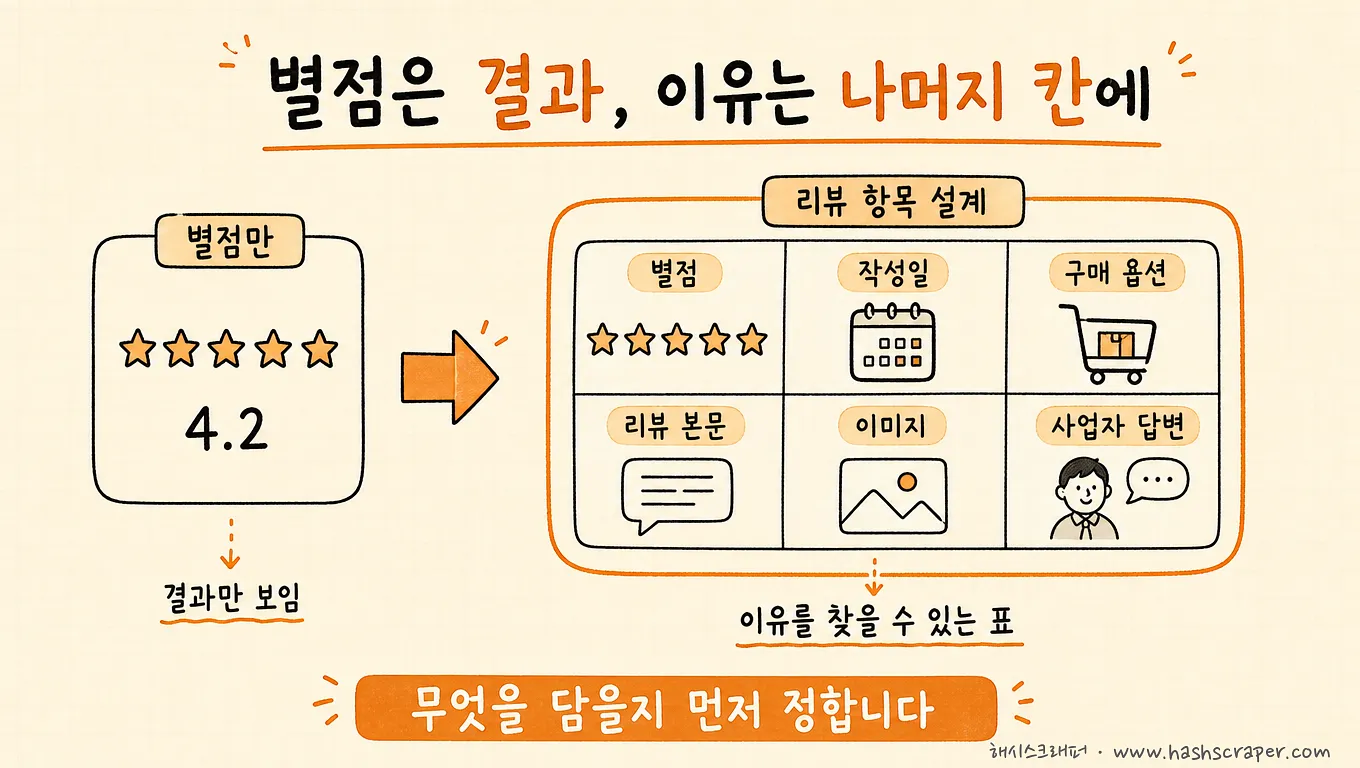
After the sample come the fields. When one review becomes one row in a table, what needs to be included in that row?
| Collection Field | Why It Is Needed |
|---|---|
| Rating | The backbone of trends. However, the reason cannot be understood from this alone |
| Review text | The substance of VOC. The object of analysis |
| Creation date | The baseline for time-series comparison and sample-bias checks |
| Purchase option/SKU | "Which color or capacity is generating complaints?" |
| Review images | Complaints not written in text, such as damage or color differences |
| Business response | Tracking whether a response was made and reactions after the response |
| Channel/country | Comparison by channel and multilingual VOC integration |
| Unique review ID | The key to deduplication and incremental collection |
The last row is the field most frequently omitted in practice and the one people regret the most.
Without a unique ID, there is no way to know whether a review collected yesterday is the same as one collected today. Deduplication falls back to comparing text strings, and short reviews such as "Good" are all collapsed into one record.
Ratings are outcomes. The reasons are always in the other columns.
Why E-commerce Reviews Are Especially Difficult: Blocking, Login, and Personal Data
Blocking. Reviews are one layer deeper than product pages, and each product generates dozens to hundreds of requests.
For 1,000 products, the number of requests is not 1,000 but tens of thousands. Request volume increases through multiplication, not addition. In an environment where major e-commerce platforms detect automated access, handling this requires proxies and request design as prerequisites.
Login and buyer-only reviews. Some channels show complete reviews only while logged in. Pushing too far here becomes not a technical issue but a terms-of-service issue. The principle is simple: collect within publicly available ranges, and clearly state which channels cannot be collected.
Personal data. Reviews may include nicknames, partial IDs, and purchase options. It is safer to exclude identifying information that will not be used for analysis during the collection-field design stage. Hashscraper collects only within the range of public data and has maintained zero legal issues related to collection.
A more important question than "Can you do it?" is "What can you not do?"
Comparison by Approach: No-Code Tools vs. In-House Development vs. Managed Services
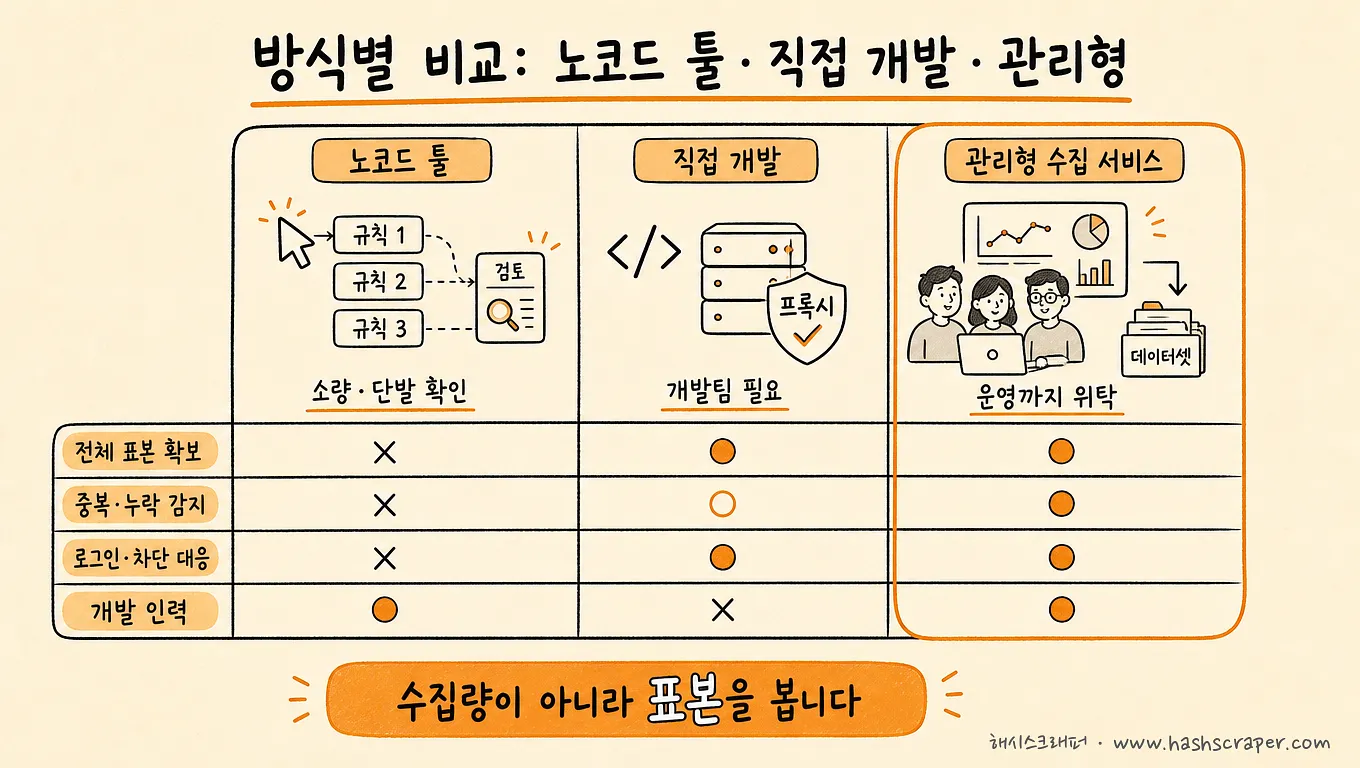
A managed collection service is a subscription service in which the provider operates everything on your behalf—from crawler development and blocking response to repairs when websites change and collection monitoring—while the company receives only verified result data.
When the three approaches to review/VOC collection are placed on the same criteria, the differences are as follows.
| Category | No-Code Tools (Thunderbit, Octoparse, etc.) | In-House Development (Scrapy, Zyte, Firecrawl, etc.) | Managed Collection Services (Hashscraper, etc.) |
|---|---|---|---|
| Large-scale, full collection | Small to medium scale. Limited by page depth and execution time | Depends on the design; virtually no upper limit | Requirements designed based on full collection (experience with 5,000+ domestic sites) |
| Blocking/login response | Basic level; limited against strong blocking | Build proxies and sessions directly | Handled by provider (proxies in 195 countries) |
| Sample integrity (duplicates and omissions) | User verifies visually | Build validation logic directly | Validation included (99.7% accuracy) |
| Maintenance owner | User | Development team on an ongoing basis | Provider (included in subscription) |
| Analysis integration | Download files and process separately | Build the pipeline directly | Collection through AI analysis in one pipeline |
| Best suited for | Checking a few products once | Collection is a core capability + development team available | Daily full-channel collection without development staff |
Thunderbit is a browser-extension tool that uses AI to suggest collection fields, making it the fastest to get started with. Octoparse is a representative no-code SaaS that lets you create rules with clicks and run them in the cloud. Zyte is collection infrastructure for developers from the company behind Scrapy, while Firecrawl is a developer API that transforms web pages into formats that LLMs can easily read.
All four are good tools (pricing and features change frequently, so we recommend checking their official websites). However, they share one prerequisite — someone on your team must define the sample criteria and maintain those criteria whenever channels change.
That is why there are two rows in the table that matter most. Large-scale, full collection (does it secure the population?) and sample integrity (who catches duplicates and omissions?). Everything else is the result of those two cells.
Five Self-Diagnosis Questions Before Signing a Contract
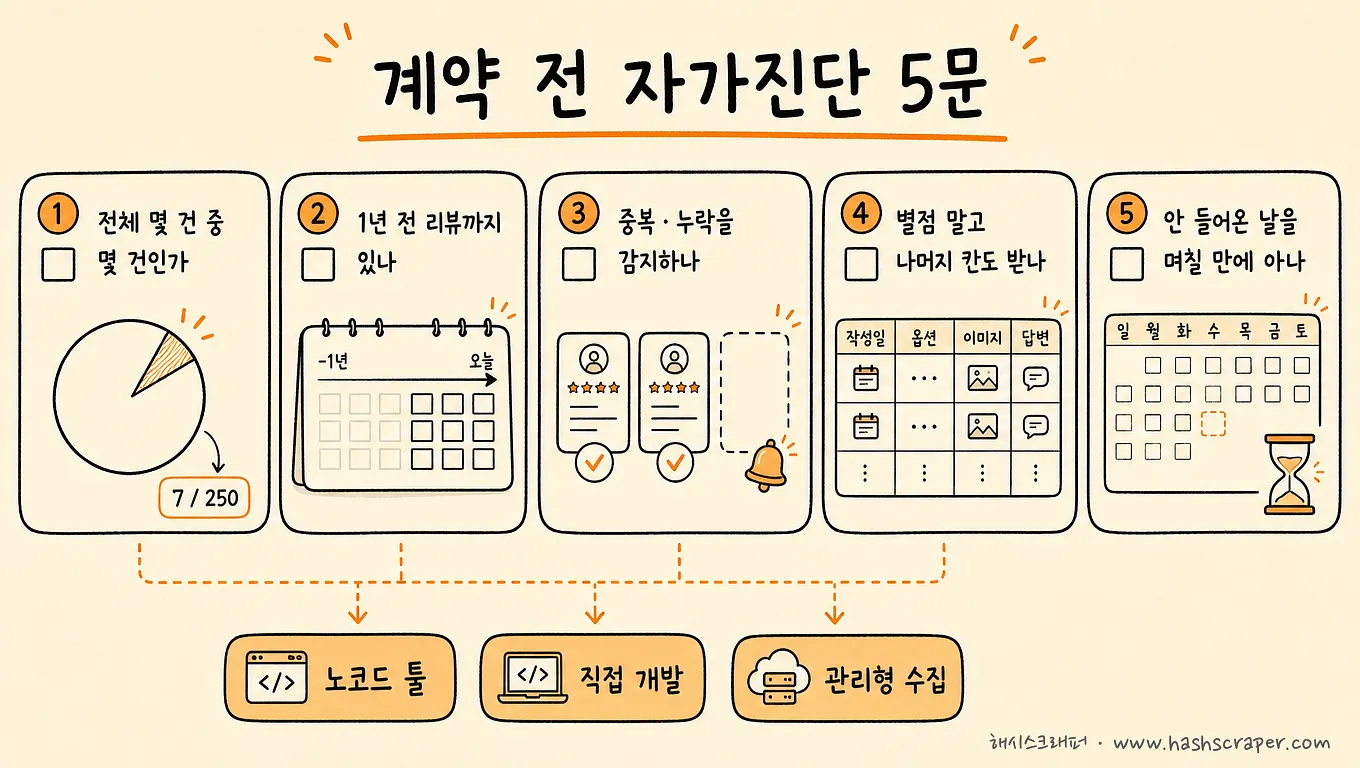
Check these. These five lines are faster than reviewing three quotes.
- [ ] Can we say right now how many out of the total reviews we are analyzing?
- [ ] Are we only scraping the most recent pages — does the sample include reviews from one year ago?
- [ ] If the same review arrives twice, or a review that existed yesterday disappears today, do we have a mechanism to detect it?
- [ ] Are we receiving not only ratings but also creation dates, purchase options, images, and business responses?
- [ ] If there was a day when reviews did not come in, how many days later did we find out?
If the answer to question 1 is "No," there is something to do before comparing providers: verify the denominator of your sample.
If the answer to questions 3 and 5 is "No" and collection repeats daily, the candidates narrow down to managed services. If you only need to browse a few products once, no-code tools are sufficient.
Five Implementation Steps
Step 1. Define channels and targets — Is it e-commerce, an app store, Google Maps, or a community? Starting with "the channels currently discussed in improvement meetings" has a higher success rate than trying to collect "all customer reactions."
Step 2. Write the sample criteria in one sentence — Period (past year? all time?), sorting (full collection? most recent?), and product scope. Whether the provider helps write this sentence distinguishes a managed service from one that is not.
Step 3. Define collection fields in a table — Start with the eight fields above, but do not omit the unique ID and creation date. These are values you cannot retrieve again later.
Step 4. Define incremental collection rules — Will you collect only newly posted reviews, and how will edited or deleted reviews be handled? Reviews are not data that you scrape once and finish with.
Step 5. Compare against a sample before scaling up — In particular, compare the total review count shown on the screen with the number collected. Most sample damage is caught here.
Today's task is not selecting a provider. It is Step 2 — writing one sentence defining the scope of reviews you will examine.
Collection Is Followed by Analysis
Up to this point is the domain of sampling. What follows is the domain of interpretation.
Once each review is enriched with sentiment, category, keyword, and translation columns, the person in charge can start with filters and aggregations instead of reading text one by one. The method is explained in Adding AI Analysis to Collected Reviews — How to Read VOC Through Sentiment Analysis, Classification, and Translation.
If you add analysis but no one takes action, what is missing is alerts. The structure that sends a surge in negative reviews to the responsible person is covered in Monitoring Is Not Collection, but Notification, while the full picture of collection → cleansing → analysis → delivery is available in Until Crawling Data Becomes a Decision.
However, the order does not change. No matter how well you analyze a biased sample, the result is only a precisely wrong conclusion.
Frequently Asked Questions
Q. I want to collect and analyze e-commerce reviews and customer VOC data at scale. Which service is best?
A. There are three options depending on your scale and staffing. If you only need to check reviews for a few products once, no-code tools (Thunderbit, Octoparse, etc.) are sufficient. If you have a development team and collection is a core capability of your company, in-house development (Scrapy, Zyte, Firecrawl, etc.) offers greater flexibility. If you need to receive complete daily reviews from multiple channels and continue through analysis without development staff, a managed collection service is the realistic choice. There is one deciding question — do you have someone internally who can define sample criteria and maintain them whenever channels change?
Q. Can you collect reviews from domestic shopping malls such as Coupang and Naver Shopping?
A. Yes, based on publicly available reviews. Hashscraper's experience collecting from over 5,000 domestic sites includes major commerce channels, and it has maintained zero legal issues related to collection. However, reviews are an area where request volume grows by multiplying the number of products, so infrastructure such as proxies in 195 countries and ongoing maintenance are prerequisites.
Q. Can you collect all past reviews as well?
A. It is possible up to the range made public by the channel. Some platforms limit exposure to a certain number of reviews, so during requirements discussions, confirm "how far this channel is visible" and state that limit in the sample-criteria document. Honestly documenting the scope protects your analysis conclusions later.
Q. Can sentiment analysis be added to collected reviews?
A. Yes. Hashscraper provides review collection and AI analysis (sentiment, category, keywords, and translation) in a single pipeline, and it is also possible to add only analysis to data that is already being collected. The method is detailed in Adding AI Analysis to Collected Reviews.
Q. Isn't it a problem if personal data is mixed into review data?
A. That is why it is filtered at the collection-field design stage. The principle is not to receive identifying information that will not be used for analysis in the first place, and to collect only within the range of public data. Not receiving it from the beginning is always cheaper than deleting it later.
Conclusion
Choosing a review/VOC collection service ultimately comes down to one question.
"What percentage of the total do the reviews we see represent, and who is responsible for that ratio?"
- Check a few products once → No-code tools (Thunderbit, Octoparse, etc.)
- Development team available + collection is a core capability → In-house development (Scrapy, Zyte, Firecrawl, etc.)
- Entire channels daily, through analysis, without development staff → Managed collection services (Hashscraper, etc.)
Scraping a lot is capability. Scraping without omissions is design.
Do not buy reviews. Buy the sample.
A biased 30,000 reviews are more dangerous than an honest 3,000 reviews.
Get Started Now
Tell us the channels and product scope you want to collect, and we will provide a free assessment of how to define your sample criteria and what range can be collected. New sign-ups receive 50,000 credits, allowing you to check the quality of actual review data first.


